
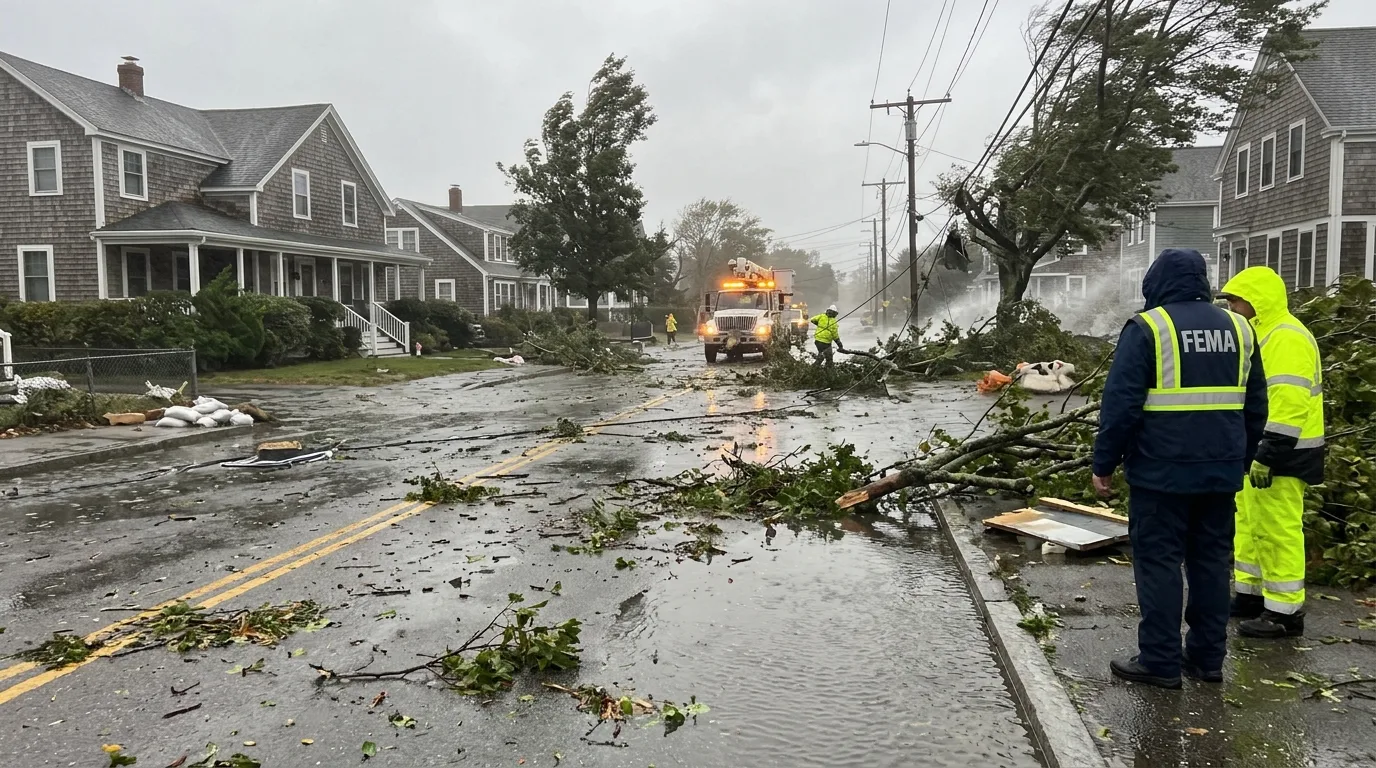
A fast-moving coastal storm is slamming the Eastern Seaboard tonight through Thanksgiving Day, bringing soaking rain, coastal flooding, and wind gusts between 55 and 70 mph from the Carolinas up through New Jersey, New York, and southern New England (FOX Weather). States of emergency are already in effect across parts of New York and New Jersey, and utility crews are bracing for widespread downed trees and snapped distribution lines right as millions of households fire up ovens and furnaces for the holiday (FOX 5 New York).
When saturated autumn soil meets 60-mph gusts, the grid fails in the most predictable way possible: shallow-rooted trees drop across overhead primary lines, knocking out power across entire neighborhoods for 24 to 72 hours. Whether it hits on Thanksgiving morning or a random Tuesday in February, a multi-day windstorm exposes the exact same weak points in a home—dead refrigerators, cold furnace blowers, and rushed generator setups that put families at risk.
If you want your house to ride out a coastal windstorm without spoiled food or frozen pipes, focus on four practical fundamentals before the lights flicker.
Separate Must-Run Circuits From Convenience Loads
The biggest mistake homeowners make during a storm outage is trying to run the entire house at once. A standard 120V/240V portable generator or mid-sized battery rig cannot carry an electric range, clothes dryer, central air, and water heater simultaneously.
Instead, isolate the handful of critical loads that actually protect your house and food:
- Refrigerators and chest freezers: A modern refrigerator pulls roughly 100 to 150 watts while running, though the compressor demands a brief 600-to-1,200-watt surge at startup. Keep doors closed and your food stays safe for hours between generator runs.
- Gas or oil furnace blowers: Even if you heat with natural gas or propane, your furnace still needs 400 to 800 watts of 120V electricity to run the igniter, control board, and air handler fan.
- Well pumps and sump pumps: If your home relies on a submersible well pump or basement sump pump during heavy rainstorms, those inductive motor loads take priority over everything else.
Before buying fuel or extension cords, run the actual math on your household’s startup surges and daily watt-hour demand using our guide to sizing backup power systems, inverters, and battery banks for blackouts.
Never Backfeed a Panel Through a Dryer Outlet
When a storm knocks out power mid-meal, frustration pushes people toward dangerous shortcuts—especially double-ended male extension cords (“suicide cords”) plugged into a 240V dryer or range outlet. Backfeeding a panel without disconnecting from the street feeds 240 volts backward through your utility transformer, stepping it right back up to 14,400 volts on the downed lines utility linemen are trying to splice outside[1].
To power hardwired circuits like your furnace blower or kitchen lights legally and safely, install a code-compliant transfer mechanism under National Electrical Code Article 702[2]. A mechanical breaker interlock plate or a dedicated transfer switch physically prevents your main utility breaker and generator input breaker from ever being closed at the same time. We break down the wiring rules, neutral-bonding requirements, and hardware costs in our comparison of generator interlock kits vs. manual transfer switches.
Enforce the 20-Foot Carbon Monoxide Rule—Even in Driving Rain
Heavy rain and 60-mph winds tempt people to pull a running portable generator inside an open garage, under a covered porch, or right up against a basement bulkhead to keep the engine dry. Every major storm season, that single decision causes preventable carbon monoxide fatalities.
According to the U.S. Consumer Product Safety Commission and the CDC, portable generators must always run outdoors at least 20 feet away from all doors, windows, vents, and air intakes, with the exhaust directed away from the house[3]. Opening a garage door does not provide enough cross-ventilation to prevent lethal CO buildup. If you have to run a generator in a coastal storm, use a rated weather canopy or generator tent designed for wet operation rather than moving the engine closer to your walls.
Pair Fuel Power With Silent Battery Storage
Running a noisy open-frame generator at 2:00 a.m. just to keep a router, a few LED lamps, and a CPAP machine alive wastes fuel and draws unwanted attention down a dark street. Pairing a portable generator with a lithium battery bank lets you run the engine for two or three hours in the morning and evening to chill the fridge and recharge your batteries, then shut the engine down for quiet overnight power. For cold-weather charging limits and cycle math, check our breakdown of LiFePO4 vs. AGM batteries for emergency backup.
References & News Sources
- U.S. Occupational Safety and Health Administration (OSHA). Using Portable Generators Safely (OSHA Fact Sheet 3282).
- National Fire Protection Association (NFPA). NFPA 70: National Electrical Code (NEC), Article 702 – Optional Standby Systems.
- U.S. Consumer Product Safety Commission (CPSC). Portable Generators Safety Guide & Carbon Monoxide Prevention.
- FOX Weather. Live Updates: Thanksgiving Storms Target 250M+ with Intense Winds, Heavy Rain, Flooding (Nov. 25, 2026).
- FOX 5 New York. Hochul Declares State of Emergency for NYC Area Ahead of Thanksgiving Storm (Nov. 25, 2026).