
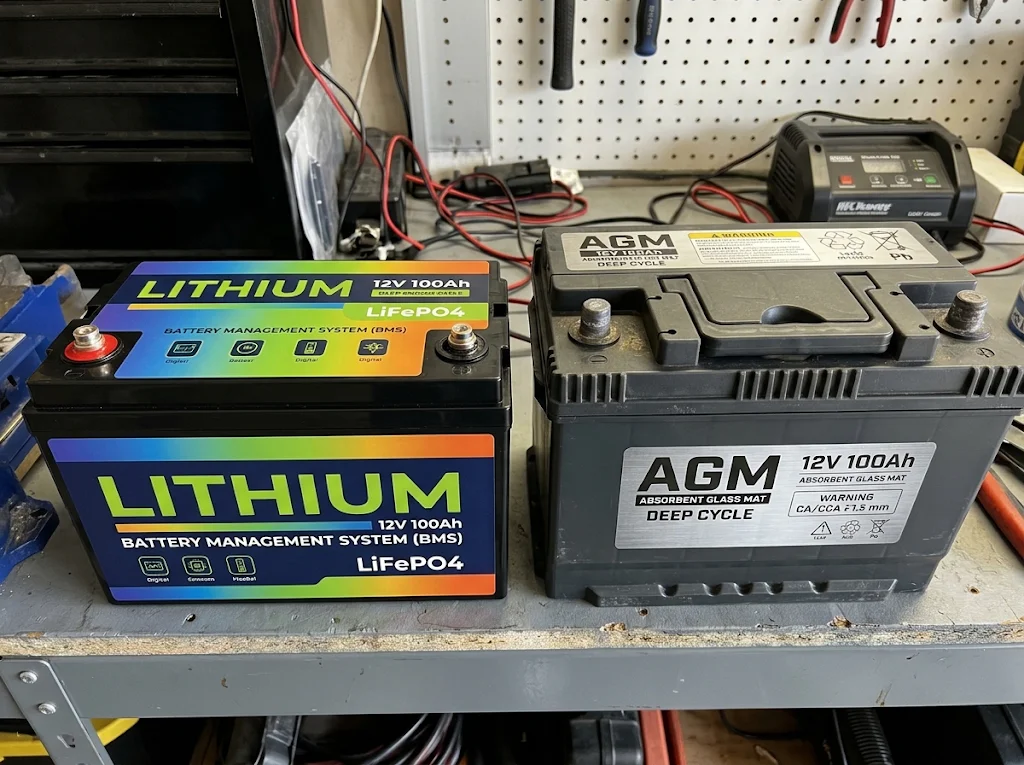
LiFePO4 vs. AGM Batteries for Emergency Backup: Cold Weather, Cycle Life & Wiring Math
When you are building a deep-cycle battery bank to keep a freezer cold or a furnace blower running through a three-day blackout, choosing between Absorbent Glass Mat (AGM) lead-acid and Lithium Iron Phosphate (LiFePO4) comes down to three hard numbers: how deep you can drain the bank without ruining it, what happens when the garage drops below 32°F, and how many times you can cycle the pack before replacing it[1][2].
A 100Ah AGM battery costs roughly half as much at the register as a 100Ah LiFePO4 battery, which tricks a lot of folks into thinking lead-acid is the budget winner[3]. Once you factor in usable Depth of Discharge, Peukert voltage sag under heavy inverter loads, and cycle lifespan, a single 100Ah LiFePO4 battery delivers almost the same usable watt-hours per blackout as two 100Ah AGM batteries—at a quarter of the weight[4][5].
Safety & Field Disclaimer: Never charge a standard LiFePO4 battery when internal cell temperatures are below 32°F (0°C) unless the pack includes an active low-temperature BMS cutoff or internal heating pads—sub-freezing charging causes permanent lithium plating and internal short circuits[6][7]. Never mix AGM and LiFePO4 batteries in the same series or parallel bank, and always verify that your AC charger or solar charge controller matches your battery chemistry’s absorption and float voltage profile[5].
Nameplate Amp-Hours vs. What You Actually Get
The biggest trap in battery shopping is treating “100Ah” as a fixed bucket of energy regardless of chemistry. As we covered in our guide on off-grid backup power sizing, you have to convert Amp-Hours into usable Watt-Hours before comparing price tags[8].
| Specification / Real-World Metric | 12V 100Ah Deep-Cycle AGM | 12V 100Ah LiFePO4 (Grade-A Prismatic) |
|---|---|---|
| Nominal Resting Voltage | 12.0V – 12.2V under load[1] | 12.8V – 13.2V flat discharge curve[6] |
| Nameplate Capacity | 1,200 Wh (at slow 20-hour C/20 rate)[9] | 1,280 Wh[6] |
| Recommended Depth of Discharge (DoD) | 50% max for normal service life[3] | 80% – 100% routine DoD[4] |
| Usable Energy Under Heavy Inverter Load | ~550 – 600 Wh (after 50% DoD & Peukert loss)[5] | 1,024 – 1,280 Wh (minimal Peukert sag)[9] |
| Cycle Life (at Rated DoD) | 300 – 500 cycles (to 80% capacity)[4] | 3,000 – 5,000 cycles (to 80% capacity)[2] |
| Physical Weight (Single 12V 100Ah Unit) | 60 – 70 lbs[3] | 22 – 30 lbs[3] |
| Safe Charging Temperature Range | -4°F to 122°F (-20°C to 50°C) with temp comp[10] | 32°F to 113°F (0°C to 45°C) unless self-heated[6] |
| Monthly Self-Discharge (Idle Storage) | 3% – 5% per month (requires float maintainer)[1] | 1% – 3% per month (store at 50%–60% state of charge)[2] |
When you do the math on usable energy, it takes two 12V 100Ah AGM batteries (roughly 130 pounds of lead) just to equal the usable watt-hours of one 12V 100Ah LiFePO4 battery (26 pounds)[3][4]. Over a 10-year emergency preparedness horizon, you will replace that AGM bank two or three times while the LiFePO4 pack is still sitting above 80% health[4].
Cold Weather Reality: Where AGM Still Holds an Edge
If your battery bank lives inside a climate-controlled basement or utility room, LiFePO4 wins on nearly every metric. If your batteries sit in an unheated detached garage, barn, or cargo van in northern winters, temperature changes the rules fast[3][4].
- LiFePO4 Low-Temperature Charging Lockout: You can safely discharge a LiFePO4 battery down to -4°F (-20°C), though available capacity dips roughly 10% to 20% in deep cold[6]. However, charging a lithium cell below 32°F (0°C) forces metallic lithium to plate onto the anode instead of intercalating cleanly, which permanently destroys capacity and creates an internal short-circuit hazard[11]. Quality batteries include a Battery Management System (BMS) with a low-temperature charging cutoff—meaning if your garage is 25°F when your generator or solar panels kick on, the BMS will slam the door shut and refuse to take a charge until the cells warm above freezing[3]. If you run LiFePO4 in cold spaces, buy self-heating models with built-in internal heating pads that divert incoming charger current to warm the cells above 35°F before charging starts[6].
- AGM Cold-Weather Tolerance: Sealed AGM batteries lose roughly 20% to 30% of their chemical capacity at 32°F (and up to 50% at 0°F), but they can still accept a charge safely well below freezing as long as your charger uses temperature-compensated voltage settings (increasing absorption voltage by roughly +3 mV per cell per °C below 77°F / 25°C)[10][5].
Charging Speed & Generator Fuel Burn
During an extended outage without sun, every hour you run a portable generator to recharge batteries burns fuel and broadcasts noise[9]. Here is how the two chemistries behave on a generator:
AGM batteries suffer from rising internal resistance as they fill up. Once an AGM pack hits roughly 80% State of Charge (SoC), the battery chokes down incoming current and enters a slow absorption stage that takes 3 to 4 hours just to pack in that final 20%[9][5]. If you shut the generator off early and leave AGM batteries chronically sitting at 80% SoC, hard lead sulfate crystals form on the plates and permanently kill the battery[1].
LiFePO4 batteries have ultra-low internal resistance and do not need a prolonged absorption soak or float charge[9]. A 100Ah LiFePO4 pack can safely accept 0.5C to 1.0C charge rates (50A to 100A), going from 10% to 95% full in 1 to 2 hours of generator runtime, and it suffers zero damage if you shut the generator down at 85% SoC[6][4].
Parallel & Series Wiring Rules That Keep Banks Balanced
Whether you wire AGM or LiFePO4 batteries into a larger 12V parallel bank or a 24V/48V series bank, sloppy cabling creates uneven current sharing that cooks one battery years before the others[5]:
- Balance every battery individually before connecting: Before bolting batteries in series or parallel, charge each 12V unit individually to 100% so resting voltages match within 0.05V[6].
- Use diagonal or busbar parallel wiring: Never connect both your inverter positive and negative leads to the first battery in a parallel string—that forces Battery #1 to do 70% of the work while Battery #4 coasts. Pull positive from one end of the bank and negative from the opposite end, or run equal-length cables from each battery to a central copper busbar[5].
- Check BMS series limits: Most budget 12V LiFePO4 batteries use MOSFETs rated for 4S maximum (48V nominal)—exceeding the manufacturer’s series limit will blow the BMS transistors the moment a single battery hits low-voltage cutoff[5].
(Planning to keep your bank topped off off-grid? Pair your battery sizing with our guides on portable power stations vs. DIY battery banks and emergency solar charging sizing to match your charge controller profile to your battery bank.)
Putting It Into Practice
For 90% of emergency backup builds stored indoors or inside a heated living space, LiFePO4 is the smarter buy—even at double the upfront sticker price, you get twice the usable capacity per amp-hour, 10× the cycle life, and half the generator fuel burn during recharges[4][9]. Reserve deep-cycle AGM strictly for unheated outbuildings where temperatures drop below freezing and you don’t want to rely on self-heating lithium pads, or for dual-purpose vehicle cranking/auxiliary setups where high cold-cranking amps matter[3].
Technical References & Sources
- Battery University (Cadex Electronics) – BU-804: How to Prolong Lead-Acid Batteries & Sulfation Mechanics (2023). ↩
- National Renewable Energy Laboratory (NREL) – Lithium-Ion vs. Lead-Acid Battery Storage Performance and Cycle Life Evaluation, TP-5400-79236 (2021). ↩
- Epoch Batteries – What Is an AGM Battery? AGM vs. LiFePO4 Technical Comparison & BMS Protection Guide (2026). ↩
- AIMS Power – LiFePO4 vs. AGM Batteries for Commercial Power Systems: Weight, Cycle Life & Temperature Performance (2026). ↩
- Victron Energy – Wiring Unlimited: Parallel/Series Bank Balancing, Absorption Profiles, and Peukert Exponent Calculations (2023). ↩
- Battle Born Batteries (Dragonfly Energy) – BB10012 / BB10012H 12V 100Ah LiFePO4 & Heated Battery Specification Sheet (2024). ↩
- Underwriters Laboratories (UL) – UL 1973: Standard for Batteries for Use in Stationary and Motive Auxiliary Power Applications (2023). ↩
- Battery University (Cadex Electronics) – BU-503: How to Calculate Battery Runtime & C-Rate Capacity Curves (2023). ↩
- Mobile Pro Systems – How to Compare AGM and LiFePO4 Batteries: Nameplate vs. Usable Storage & Charging Efficiency (2026). ↩
- Trojan Battery Company – Deep-Cycle AGM & Lead-Acid Maintenance Guide: Temperature Compensation & Cold Capacity Derating (2023). ↩
- Battery University (Cadex Electronics) – BU-410: Charging Lithium-Ion at High and Low Temperatures — Anode Plating Hazards (2023). ↩