
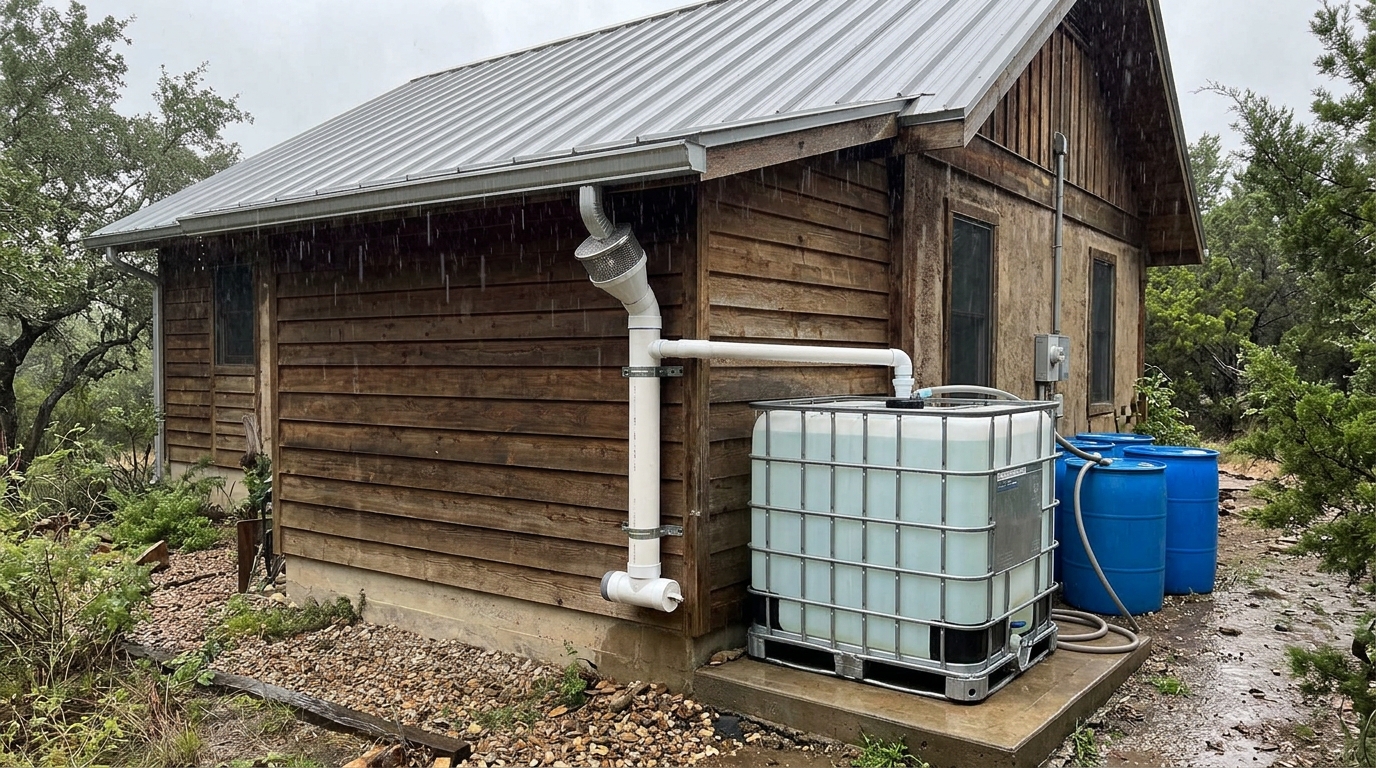
Storing water in static containers buys critical time, but every closed reservoir is ultimately a ticking clock. When municipal mains run dry and stored barrels dip toward their bottom bungs, rainwater harvesting transforms your property from a finite storage locker into an active, self-replenishing utility[1][2].
You don’t need to be a hardcore prepper for this to pay off. Drive through the high desert out Southwest, and you’ll see cisterns hooked up to regular houses everywhere. When you only get a handful of summer storms a year, catching runoff off a metal roof is just common sense—it keeps gardens alive and takes the strain off your well. Emergency or not, the setup works the exact same way.
Yet the most common advice in emergency preparedness—simply placing a barrel under an open gutter downspout—is an invitation to biological and chemical contamination[3]. Every roof functions as an environmental catchment surface that collects bird droppings (Salmonella and Campylobacter), wind-blown organic matter, heavy metals, and particulate debris[3][4]. Dumping the opening pulse of rainfall straight into your cistern turns your drinking supply into an anaerobic soup that blinds sediment filters in hours[2][5].
Safety & Field Disclaimer: Rooftop rainwater runoff is classified as untreated surface water and must undergo biological purification before human consumption[3]. Always verify state and municipal rainwater collection regulations before modifying downspouts, and ensure structural foundations are engineered for full liquid loads[1][13].
Catchment Yield Mechanics: The Mathematical Baseline
Before buying fittings or setting tanks, verify that your roof can physically produce the volume your household demands using the standard hydrological formula[2][7]:
Runoff (Gallons) = Catchment Footprint Area (sq ft) × Rainfall Depth (Inches) × 0.623 × Runoff Efficiency Coefficient (e)
- The Constant (0.623): One inch of water spread uniformly across one square foot of surface equals 0.6233 U.S. gallons[2][7].
- Footprint Area: Use the horizontal footprint of your roof structure, not the pitched surface area. A 40 × 30 ft ranch house has a horizontal catchment footprint of 1,200 sq ft regardless of whether the pitch is 4/12 or 12/12[2][8].
- Runoff Coefficient (e): Water is lost to surface absorption, splash-out, gutter evaporation, and wind drift[2][8].
Catchment Reality Check: A 1,500 sq ft seamless metal roof during a moderate 1-inch rainfall event generates 888 gallons (1,500 × 1.0 × 0.623 × 0.95)[2][7]. Even a brief thunderstorm will fill a pair of 275-gallon IBC totes or sixteen 55-gallon drums, provided your gutter throats and downspout outlets can handle the flow velocity without overflowing[2][8].
Roofing Chemistry: What Is Leaching Into Your Water?
- Standing-Seam Metal (The Gold Standard): Factory-painted, baked-on enamel standing-seam metal or Galvalume panels provide the cleanest harvest profile[1][2]. Metal heats rapidly under direct sunlight, accelerating thermal destruction of pathogens deposited between storms, and sheds zero mineral grit[2].
- Asphalt Shingles (The Chemical Hurdle): Over 75% of American suburban homes use asphalt fiberglass shingles[4]. Shingles continuously shed fine ceramic-coated mineral grit, leach trace polycyclic aromatic hydrocarbons (PAHs) as sunlight breaks down petroleum binders, and often release copper or zinc from moss-inhibiting granules[3][4][9]. If your only catchment surface is asphalt shingle, mechanical first-flush diversion plus dense carbon block filtration (certified to NSF/ANSI Standard 53) is mandatory before consumption[4][11]. For downstream purification details, see our guide to off-grid gravity water filtration systems.
First-Flush Mechanics: Eliminating the Initial Contaminant Pulse
When rain begins, water acts as a solvent, scouring accumulated biological waste, soot, and road dust off your roof. Water quality testing confirms that the vast majority of microbiological pathogens, total dissolved solids (TDS), and turbidity are concentrated in the first 1 to 2 millimeters (0.04 to 0.08 inches) of precipitation[5][6].
A First-Flush Diverter is a zero-power vertical PVC column featuring an internal floating poly ball and neoprene seating gasket[5][6]:
- Initial Diversion: Dirty runoff enters the top tee and drops straight down into an empty vertical PVC pipe chamber[6].
- Pathogen Trapping: The first 10 to 50 gallons of wash water collect in this column, trapping suspended sand, bird feces, and dissolved chemicals[5].
- The Seal: A hollow, high-buoyancy poly ball floats up with the rising water column and wedges firmly against an elastomeric rubber seat inside the upper tee once the chamber fills[6].
- Clean Diversion: With the check valve sealed, subsequent clean rain cascades across the tee junction straight into your cistern[6].
- Slow Drain Reset: A slow-drip emitter at the base bleeds off the dirty water over 24 to 48 hours, dropping the ball back to the bottom to reset for the next storm[5][6].
Engineering First-Flush Sizing
The most common failure point in DIY systems is undersizing the diversion chamber. Diverting 2 gallons off a 1,500 sq ft roof barely wets the gutters[5]. Size your chamber based on site pollution levels[1][5]:
- Low-Pollution Environment (1.0 Gal / 100 sq ft): Metal roof, open rural terrain, zero overhanging trees, frequent rain[1][5].
- Moderate Pollution (1.5 Gal / 100 sq ft): Suburban lot, asphalt shingles, moderate traffic soot, light tree canopy[5].
- High Pollution / Long Dry Spells (2.0 Gal / 100 sq ft): Dense overhanging trees, heavy bird activity, nearby dirt roads, or dry spells exceeding 3 weeks[5][6].
Pipe Sizing Rule of Thumb: For standard 8-to-10-foot residential eaves, use 6-inch Schedule 40 PVC (which holds 1.50 gallons per linear foot, so a 6.7-foot vertical drop diverts roughly 10 gallons) rather than 4-inch pipe (which holds only 0.66 gallons per foot and requires over 15 feet of vertical height for the same 10-gallon capacity)[16].
The Four-Barrier Pre-Storage Defense
- Gutter Mesh Guard: Heavy-gauge mesh over the gutter trough blocks gross leaves and twigs[2].
- Rain Head (Leaf-Eater): Angled self-cleaning stainless steel screen (0.95 mm mesh) on the downspout sheds organic debris onto the ground while letting water drop through[6].
- First-Flush Diverter: Isolates settled silt, bacteria, and chemical residues below the leaf slide[5][6].
- Tank Inlet Basket: A removable 100-mesh nylon or stainless steel strainer basket in the cistern lid blocks fine pollen and mosquitoes[1][2].
Cistern Plumbing & Foundation Loads
- Structural Foundations: Water weighs 8.34 pounds per US gallon[12]. A 55-gallon drum weighs ~480 lbs, a 275-gallon IBC tote weighs ~2,418 lbs[12][13], and a 1,000-gallon polyethylene tank weighs ~8,600 lbs (including ~260 lbs tank tare weight)[12][17]. Bulk tanks must rest strictly on level, compacted gravel pads or 4-inch steel-reinforced concrete slabs—never on uncompacted soil or wood framing[1][13]. See our guide to long-term potable water storage for full structural load specs.
- Calmed Inlets: Run the tank inlet pipe down the inside wall to the cistern floor, terminating in an upward-facing U-bend (“calmed inlet”) so incoming rain doesn’t churn up settled sediment[1][6].
- Floating Outlets: Suspend a flexible intake hose from a hollow poly float ball 6 to 8 inches below the water surface to draw from the cleanest stratum—avoiding floating pollen on top and anaerobic sludge on the bottom[1][6].
Freezing Vulnerability & Winterization
Water expands by approximately 9% when freezing, generating internal pressures exceeding 20,000 to 30,000 PSI that easily split rigid PVC[14][15].
- Winter Bypass Gate: Install a manual bypass valve to route winter snowmelt to standard ground drainage[14].
- Drain the Diverter: Leave the bottom cap or drain valve of vertical PVC diversion columns open all winter so standing water cannot freeze solid[14].
- Ice-Expansion Mitigators: Keep outdoor tanks at least 15% below maximum capacity in freezing climates, and float half-filled closed HDPE bottles weighted with pea gravel to absorb lateral ice expansion[14].
The Preppers Gab Field Verdict
- Catchment Selection: Prioritize standing-seam painted metal for potable setups; pair asphalt shingle roofs with NSF/ANSI 53 activated carbon block filtration[1][4][11].
- Diversion Rule: Size first-flush chambers to at least 1.5 gallons per 100 sq ft of roof footprint[5][6].
- Hydraulic Hygiene: Combine leaf-slide downspout heads, calmed inlets, and floating outlets to keep cistern water clear[6].
- Post-Purification: Always treat harvested rainwater as raw surface water—run it through an off-grid gravity water filtration system or secondary emergency chemical water disinfection before drinking[3][11].
Technical References & Sources
- Texas Water Development Board (TWDB) – The Texas Manual on Rainwater Harvesting, 3rd Edition (2020). ↩
- American Rainwater Catchment Systems Association (ARCSA) & ASPE – Standard 63-2020: Rainwater Catchment Systems (2020). ↩
- Centers for Disease Control and Prevention (CDC) – Rainwater Collection: Potential Health Risks, Contaminants, and Safe Use Guidelines (2024). ↩
- U.S. Environmental Protection Agency (EPA) – Rooftop Runoff Quality and Contaminant Leaching from Common Roofing Materials, Technical Bulletin 600/R-14/150 (2022). ↩
- Doyle, R., & Gardner, E. (Journal of Hydrological Engineering) – Evaluating First-Flush Diversion Volume Requirements for Urban and Rural Rainwater Cisterns, Vol. 26(4) (2021). ↩
- Rain Harvesting Pty Ltd – First Flush Water Diverter Sizing, Flow Dynamics, and Hydraulic Check-Valve Mechanics (2024). ↩
- U.S. Geological Survey (USGS) – Rain and Precipitation Runoff Calculations and Conversion Formulas (2023). ↩
- International Association of Plumbing and Mechanical Officials (IAPMO) – Uniform Plumbing Code (UPC), Chapter 16: Nonpotable and Potable Rainwater Catchment Systems (2021). ↩
- Mendez, C. B., et al. (Water Research) – The Effect of Roofing Material on Water Quality for Rainwater Harvesting Systems: PAHs and Microbiological Assessment, Vol. 45(5), 2041–2052 (2011). ↩
- World Health Organization (WHO) – Guidelines for Drinking-Water Quality: Chemical Contaminants from Roof Runoff, 4th Edition (2022). ↩
- NSF International – NSF/ANSI Standard 53: Drinking Water Treatment Units – Health Effects (2025). ↩
- Engineering ToolBox – Water Density and Specific Weight Across Operational Temperatures (2022). ↩
- International Code Council (ICC) – International Residential Code (IRC), Section R301.5: Minimum Uniformly Distributed Live Loads and Foundation Slabs (2021). ↩
- U.S. Army Public Health Center – Cold-Weather Water Storage, Freeze Prevention, and System Winterization, Technical Guide 318 (2021). ↩
- National Research Council of Canada – Phase Change Expansion Pressures of Confined Water in Rigid Polyethylene and Metallic Conduits, NRC Publications Archive (2020). ↩
- Charlotte Pipe and Foundry – PVC Schedule 40 & SDR-35 Pipe Dimensions, Wall Thickness, and Internal Capacity Specifications (2023). ↩
- Norwesco Inc. – Vertical Polyethylene Water Storage Tank Specifications: 1,000 Gallon Tare Weight & Footprint (2024). ↩